
Stop Fixing Flaws. Start Multiplying Strengths.
Most feedback is noise. Here’s how top performers—and Level 4 leaders—filter for what actually drives growth.

The most successful people you know aren’t flawless.
They didn’t get there by fixing every weakness.
They got there by doubling down on their superpower and neutralizing anything that could stall momentum.
That’s it. That’s the game.
🔁 The Common Trap: Treating Feedback Like a To-Do List
Most people treat every piece of feedback as something to fix.
They spread themselves thin. They chase “well-rounded.”
They end up average at everything and exceptional at nothing.
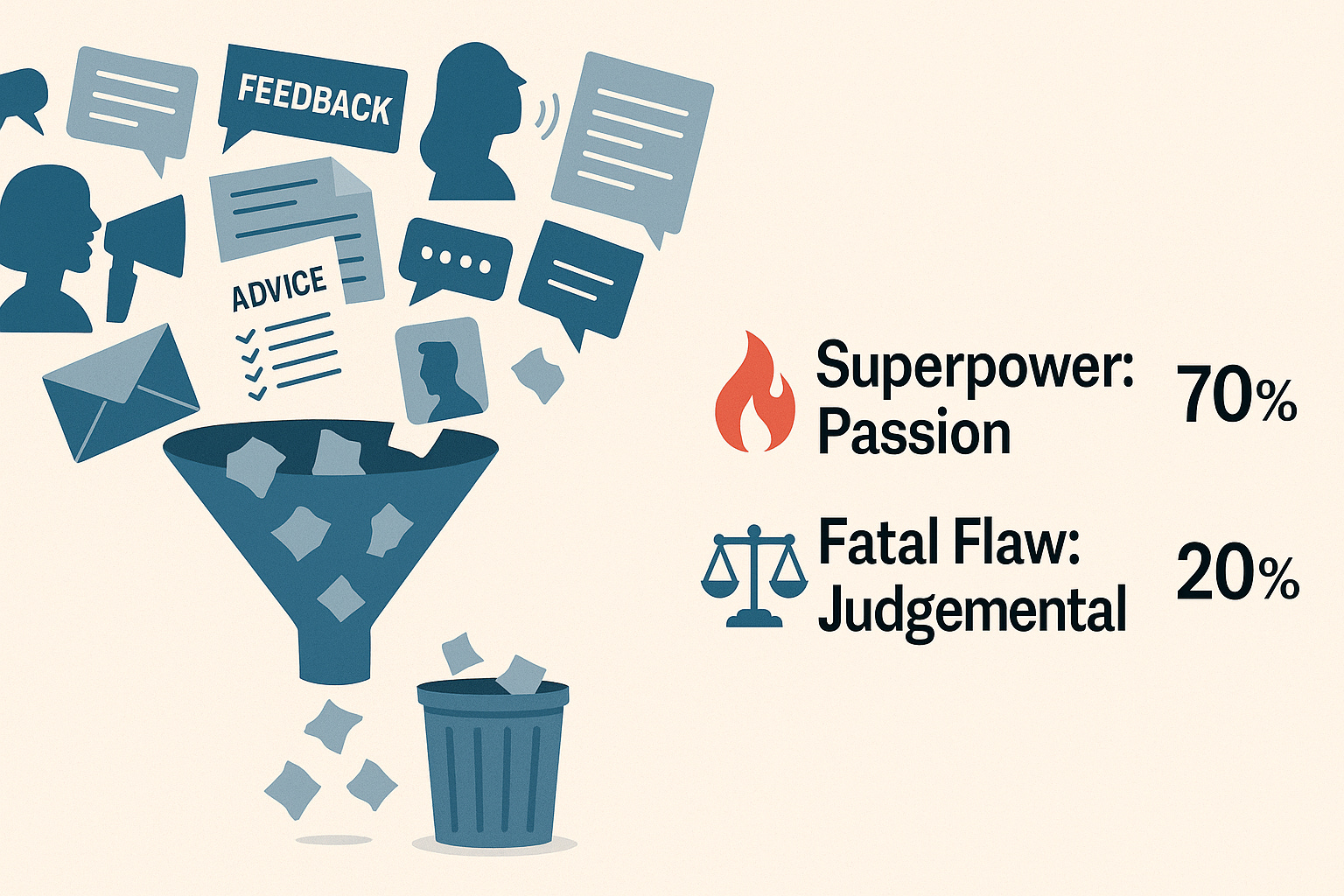
Top performers do the opposite. They use feedback as a filter, not a checklist.
They ask:
Does this sharpen my superpower?
Is this a fatal flaw that needs to be neutralized?
Or is this just noise that sounds smart but adds no real leverage?
That’s how elite operators grow with intention, not confusion.
⚙️ The 70 / 20 / 10 Formula
70%: Amplify your superpower
This is your edge. The trait that makes you valuable, trusted, and impactful.
Spend most of your energy sharpening it, applying it, and making sure others see it.
20%: Neutralize fatal flaws
You don’t need to master every weakness.
But if there’s something that could cost you deals, credibility, or trust, you can’t ignore it.
Handle it just enough to avoid damage. Then move forward.
10%: Ignore the rest
Not every flaw deserves your energy.
Not every piece of feedback is useful.
Most of it reflects someone else’s preferences, not your purpose.
🧠 How to Coach Others Using This
If you’re a leader, this isn’t just a personal principle.
It’s your coaching framework.
Bad managers try to make everyone well-rounded.
Great leaders help people get spiky.
Use the same formula:
70%: Help them go all-in on what makes them shine
20%: Step in early to neutralize what might hold them back
10%: Let go of the minor distractions
⚠️ The Two Most Common Leader Traps
Even experienced leaders fall into these two patterns:
1️⃣ Evaluating others through your own strengths
You’re great at building trust, so you undervalue the rep who closes with logic and ROI.
You grind through 80-hour weeks, so you dismiss the one who gets results in 50.
That’s not leadership. That’s projection.
True leadership means:
Seeing and respecting someone else’s strengths, even if they look nothing like yours
Helping them build mastery in their lane, not forcing them into yours
Saying: “You don’t need to be like me. You need to be the best version of you, and I’ll help you get there”
2️⃣ Trying to create symmetry
You deliver balanced feedback. Everyone gets rated on the same skills. Every scorecard looks identical.
That sounds fair. But here’s what happens:
Your top performers feel unseen
Your mid-performers get pulled in too many directions
Your low performers feel like they’re failing everywhere
Instead of symmetry, focus on leverage.
Your job is not to create balance. It’s to help each person create asymmetrical advantage.
🔄 What Changed for Me
When I became an RVP at Salesforce, I thought my job was to scale my own impact.
So I coached my team on the things I was great at.
It made sense on paper. But I was just building clones.
I wasn’t unlocking their strengths. I was imposing mine.
Later, while leading the Insurance vertical at DocuSign, I realized something important.
My job wasn’t to make people strong in my strengths.
It was to help them get stronger in theirs.
That shift marked the moment I moved from being a high-output leader to becoming what I now call a Level 4 leader.
📈 What Is Level 4 Leadership?
I break this down in more detail in my article:
👉 Evolving as a Leader: Why the Ladder Matters
Here’s a quick summary:
Level 1: Individual contributor (drives own performance)
Level 2: Manager (drives team execution)
Level 3: System builder (scales process and structure)
Level 4: Potential-maximizing leader (raises what others believe they are capable of)
That last level is where it gets exciting.
A Level 4 leader doesn’t just scale themselves. They scale belief.
When I heard Dr. R K Gajjar, the VC of Gujarat Technology University fire up her team with a bold dream that: “We’ll create one unicorn, one Nobel Laureate, and one Olympian.”, it reminded me that’s what it sounds like when leadership becomes expansive.
Not just focused on tasks. Focused on potential.
🧩 How to Apply This With Your Team
Run this as a team exercise. It’s fast and powerful.
Ask each person to write down their own superpower in one sentence
Have their peers write down what they see as each person’s top strength
As a leader, reflect back the strength you see—with examples
Share in a group session (30 minutes is enough)
Ask each person to create a short action plan with 3 ways to apply or sharpen their edge over the next month
Revisit it quarterly in 1:1s
The result is confidence, clarity, and momentum.
💥 Common Pushback (and Why It’s Wrong)
“Shouldn’t we aim to be well-rounded?”
No. That creates mediocrity. Top performers are spiky. They scale what makes them great and protect against what could drag them down.
“Isn’t this ignoring growth?”
This is focused growth. Not all improvement is worth the effort. This model prioritizes what drives leverage.
“What if I have multiple strengths?”
Choose the one with the highest impact. Build depth before chasing breadth.
“Won’t people coast with this model?”
It’s actually harder. It demands excellence. Most people avoid going deep. This system makes them face that head-on.
🔥 TL;DR
Use feedback as a filter, not a to-do list
Sharpen your edge
Neutralize fatal flaws
Ignore the noise
Coach your team the same way
Don’t project your style
Don’t force balance
Help people become exceptional at what matters
Want More Like This?
📩 Subscribe to GTM Simplified